Never forever
By Steven Russell

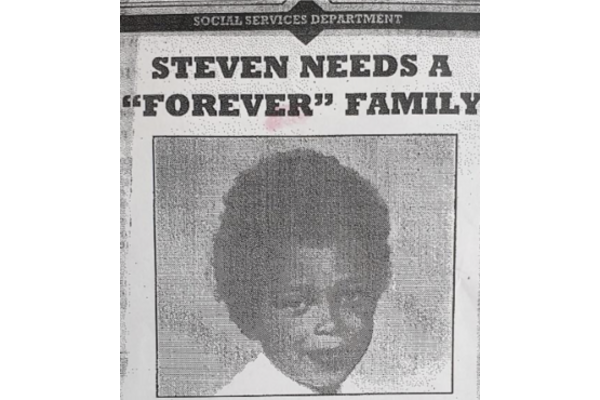
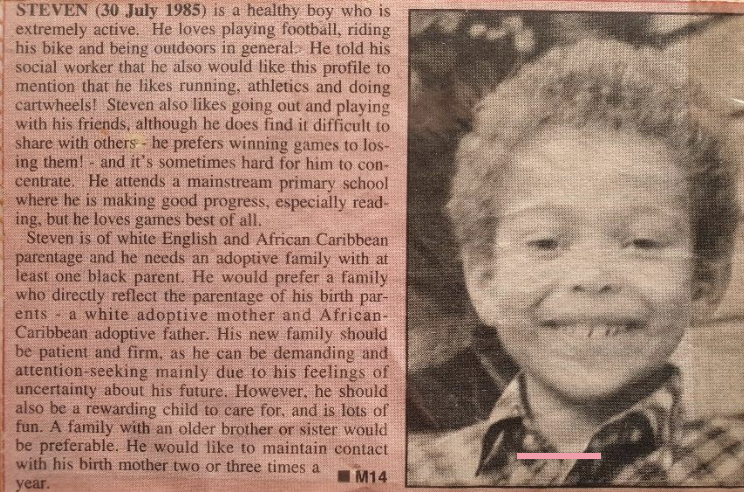
I was seven years old the first time I saw myself in print.
Not in a school photo. Not on a certificate stuck to somebody's fridge. In a newspaper. A small appeal, tucked between the local news and the adverts, and above it sat a few words that would follow me for the rest of my life.
Before I tell you what they did to me, let me show you what they said.
Social services department
Steven needs a "forever" family
Steven is now 7 and waiting to join his forever family. He is an active little boy who enjoys riding his bike and playing outside. He loves pets.
Steven is unsettled because there have been so many changes of plan for his future. He can be demanding and attention seeking, but with a patient and firm family Steven should be a rewarding child to parent.
If you can help or would like more information please contact the Area Office, The Council House, Sutton Coldfield.
Birmingham City Council
That little boy is me.
Sit with that for a moment before you read on. Because I need you to see him, really see him, the way strangers over their morning tea once did. A child, described in a few short lines, offered to the world like something on a page you might flick past on the way to the sport.
Read the words again. Active. Loves pets. Unsettled. Demanding. Attention seeking. And there, right at the top, the promise that would come to haunt me. Forever.
The weight of a single word
Children in care listen very carefully to language. We have to. When your sense of safety has been rearranged more times than you can count, words become the ground you try to stand on. So, when an adult says forever, a child does not hear a recruitment phrase. A child hears a vow.
Here is the quiet heartbreak of it. So often, forever turned out to be until. Until things got difficult. Until a home became heartbreak. Until a carer's circumstances changed. Until I was moved on again, bags packed, sitting in the back of another car, watching another front door grow smaller in the wing mirror.
Nobody set out to lie to me. I want to say that clearly, because this is not a story about blame. The carers who took me in were, in the main, kind and well-meaning people doing an extraordinarily hard thing. But every time forever became temporary, something inside me learnt to brace. I stopped hearing forever as a promise. I started hearing it as a countdown.
That is what the language did to me. Not the people. The language.
Look again at the words they chose
Go back to that flyer for a second. Notice the line that says I could be demanding and attention seeking.
I was a small boy who had known too much change. Of course I sought attention. I was reaching for connection the only way I knew how. Behaviour is a form of communication, and mine was saying something very simple. See me. Stay. Do not leave like the others did.
But the words on that page did not read like a cry for connection. They read like a warning label. A gentle heads up to any family thinking of choosing me. And a child does not need to understand marketing to feel the sting of being described that way in public.
Think about the young people on your caseload, in your classroom, at your kitchen table right now. How often does the language in a file, a referral, a review describe the behaviour and miss the child entirely? How often do we write challenging when we mean hurting?
What forever asks of a child
When we tell a child they are getting a forever family, we are asking them to hope with their whole heart. We are asking them to hand over the most fragile thing they own, their trust, and to believe that this time will be different.
When it is not, the child rarely blames the word. They blame themselves. I certainly did. I did not think that the language was wrong. I thought I was not good enough to be somebody's forever. I carried that quiet verdict around for years, long after I had left care, long into the two decades I later spent working inside the very system that raised me.
That is the strange gift of a dual perspective. I have sat on both sides of the clipboard. I have been the boy in the newspaper, and I have been the professional writing the reports. From both chairs, I have watched how easily our language can wound the very children we are desperate to protect.
Sitting with the words we use
So, I am not asking you to care less fiercely. Please, care more. I am simply asking you to sit for a moment with the words we hand to these children.
A foster carer might genuinely be somebody's forever. That does happen, and when it does, it is one of the most beautiful things this work can offer. But forever is not ours to promise on behalf of a system that cannot always keep it. What we can promise is presence. Honesty. Turning up today, and then again tomorrow, and then again, the day after that.
That is where real change lives. Not in one grand vow, but in the small, steady, unglamorous business of showing up. Being patient. Being curious. Being there when it is easy and when it is not. Drip by drip, day by day, that is how trust is rebuilt in a child who has learnt to brace.
Here is my gentle ask of you, whether you are a foster carer, a social worker, or someone shaping the way we speak about these children.
Sit with the language you use. Notice the promises hidden inside it. Read the words on the file the way a frightened child would read them. Ask yourself whether a young person could reasonably hold you to every word, and whether you would want them to.
Say what you can honestly keep. Then keep it.
Because to the world, an appeal in a newspaper may only be a handful of words. But to one small boy, folded into it, those words became the story he told himself for a lifetime.
Let us make sure it is a story worth believing.
Drip By Drip Day By Day: Finding Purpose Through The Pain by Steven Russell